

“Higher self” can describe the part of you that feels connected to your values, perspective or spiritual beliefs. When life is full of other people’s needs, that language may help you pause and ask what matters to you, too.
You do not need to prove that a message has arrived. A quiet moment, a dream or a repeating number can feel meaningful without telling you what another person thinks or guaranteeing a future event. You can reflect on the meaning while checking the decision in front of you.
On this page
Make a little room to hear yourself
Choose a pause that fits the day you are having. You might sit by a window, step outside or write a few lines after a task. If you are responsible for children or someone else’s care, plan the pause around safe supervision and the support you actually have.
There is no required posture, length or feeling. Ask one question: “What have I been putting aside?” The answer might be rest, company, reassurance, privacy or help with a task. It may also be “I don’t know yet.”
Meditation is one option, rather than a test of spiritual commitment. If focusing inward makes you uncomfortable, open your eyes, stop and try another activity. The NHS notes that mindfulness is not right for everyone. You do not have to push through distress to show that you are listening.
Notice patterns without demanding certainty
A number that catches your attention can become a personal reminder to pause. It does not require a purchase, a message to an ex or an immediate life change. Before acting, ask what you already know and what remains uncertain.
Dreams may bring up memories, hopes or worries. If you understand a dream through your spiritual beliefs, you can hold that interpretation gently. Its emotional importance does not establish that a deceased loved one sent it or that an event will happen.
Try separating three short notes: what you noticed, what it means to you and what action would be sensible anyway. For example, noticing a familiar number might remind you that you want more contact with friends. Sending a low-pressure invitation is a choice you can make without needing the number to predict a response.
Bring your needs into relationships
You can enjoy spending time with people whose beliefs differ from yours. Agreement about every spiritual idea is not a requirement for care, trust or friendship. Look at how you treat each other, whether there is room for disagreement and whether your limits are respected.
If a relationship leaves you exhausted, identify the behaviour before making a broad judgement about someone’s “energy.” Is the person calling late, interrupting, demanding money or dismissing a request? A specific concern gives you something clearer to respond to.
You might say, “I care about you, but I can’t talk tonight. I can check in tomorrow afternoon.” A boundary concerns what you are willing and able to do. It does not require persuading the other person to adopt your beliefs.
You do not owe continued access to someone who pressures or threatens you. If you feel unsafe, seek support suited to the situation rather than relying on a spiritual sign to tell you whether the behaviour matters.
Turn reflection into a small choice
After a pause, choose one response that fits the need you noticed. If you need rest, consider what can wait. If you want connection, choose someone you feel comfortable approaching. If you need practical help, name the task rather than hoping someone will sense it.
Use this short prompt: “Today I noticed ___. What I need may be ___. One thing I can try is ___.” These are your working notes, not a prediction or a promise.
Leave room for mixed feelings. You can feel compassion and still be angry, want solitude and still need company, or care about a relationship and decide that it is not working. None of those combinations means you have failed to connect with yourself.
Review how the practice affects you
Notice whether reflection leaves you clearer about a request, a limit or a next step. If it becomes a search for signs that you cannot stop checking, reduce the practice and reach out to someone you trust. Persistent distress or disruption to daily life is a reason to seek professional support.
You do not need to manifest miracles to have a meaningful inner life. Listening to yourself can be as ordinary as acknowledging a feeling, asking for help or changing a plan that asks too much of you.
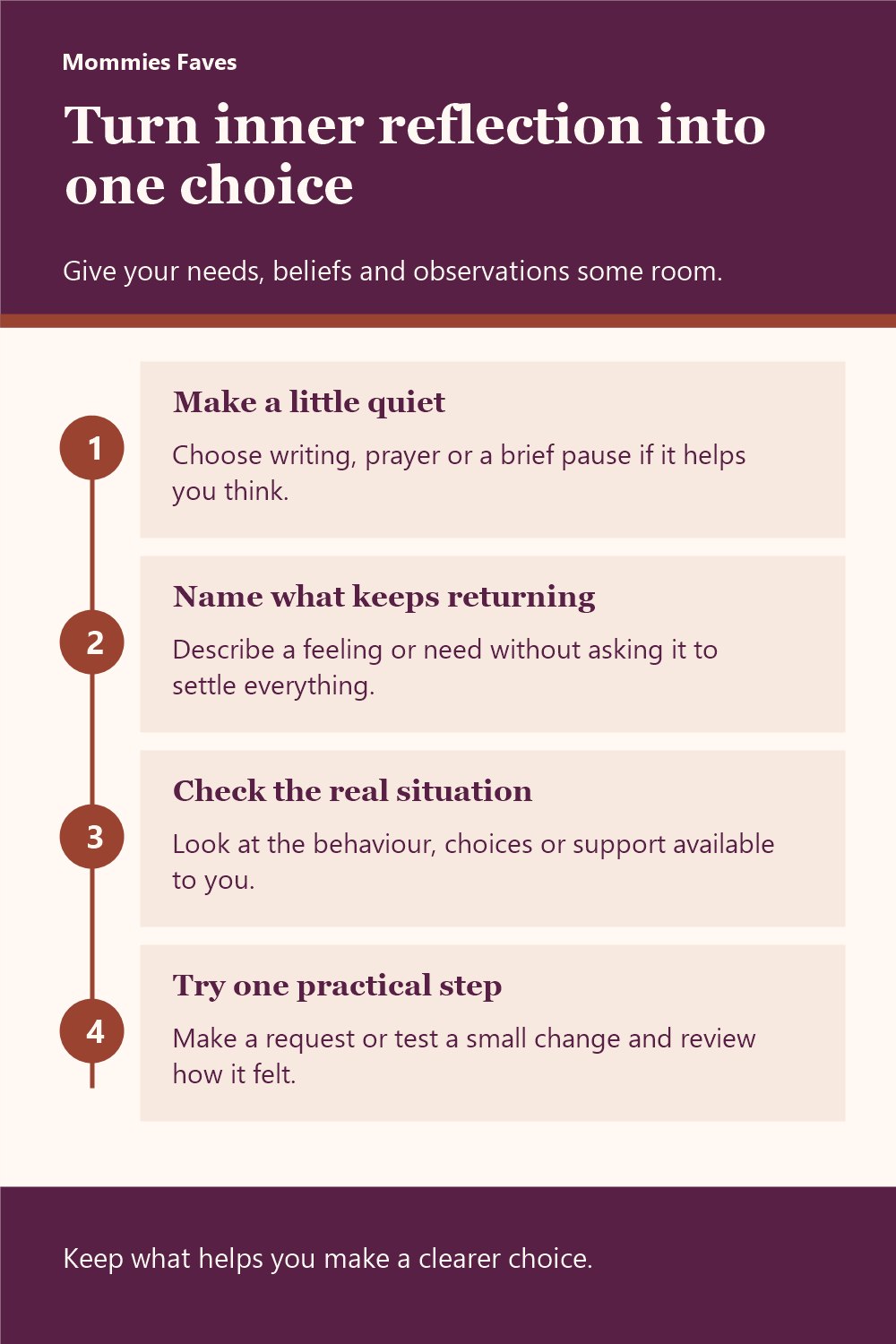
Read the infographic in text
Turn inner reflection into one choice Give your needs, beliefs and observations some room.
- Make a little quiet Choose writing, prayer or a brief pause if it helps you think.
- Name what keeps returning Describe a feeling or need without asking it to settle everything.
- Check the real situation Look at the behaviour, choices or support available to you.
- Try one practical step Make a request or test a small change and review how it felt.
Keep what helps you make a clearer choice.