

A relationship can add affection, companionship and practical support to your life without being the only place you find happiness. You can enjoy closeness and still need friends, rest, interests and time alone. When you feel unhappy, it helps to look at both your circumstances and the way you are treated, rather than assuming that you or your partner must be the whole problem.
In this article
Make happiness more specific
“I want us to be happier” can mean several things. You might miss affection, need more help at home, want less conflict or feel worn down by circumstances outside the relationship. Name a recent moment that captures the difficulty. A concrete example is easier to discuss than a judgment about the entire partnership.
Ask what you hoped would happen and what actually happened. Perhaps you wanted a quiet evening together, but both of you worked late and then argued over chores. There may be a practical problem to solve, a request to make or an expectation to reconsider. One disappointing evening does not answer every question about the relationship.
You do not have to feel happy all the time for a relationship to matter. Equally, good memories do not require you to dismiss a continuing problem. Look at patterns alongside individual moments.
Keep sources of support beyond the relationship
Consider what gives your week variety or steadiness: a friend you can call, time outdoors, a familiar hobby or a little uninterrupted rest. You do not need an impressive self-care routine. Choose something that fits your energy, money and responsibilities.
Being sad when a partner is away, or wanting reassurance after a difficult day, does not by itself show that you are overly dependent. People affect one another. The useful question is whether you have room to express needs, make choices and maintain other connections without punishment or pressure.
Independence is also practical. Discuss how each person can have personal time while shared responsibilities are covered fairly. If one partner gets regular breaks because the other always takes over, the arrangement may need changing. A request for rest is not a failure to appreciate your family.
Ask for care without assigning every feeling
A partner cannot manage every emotion for you, but their actions can still hurt or support you. Taking responsibility for your response does not mean pretending that broken agreements, insults or indifference have no effect. You can name the behaviour and ask for a change.
Try a request with a clear action: “Could we put our phones away while we eat?” or “When our plans change, please tell me before I start getting ready.” Let the other person explain what they can offer. A conversation can reveal a workable adjustment or a real difference in what you each want.
Reassurance is most useful when it sits alongside follow-through. Repeating the same reassuring words while the same hurtful behaviour continues may leave the original issue unresolved. Notice what changes after a discussion, rather than judging yourself for still having feelings.
Notice how everyday life is shared
Affection can be expressed through attention, reliability and ordinary care as well as special occasions. Consider who plans meals, remembers appointments, checks in after a hard day or makes time for an enjoyable activity. Some contributions are easy to overlook because they happen quietly.
Appreciation and fairness belong together. You can thank someone for a helpful action and still discuss an uneven workload. Avoid turning the conversation into a contest over who suffers more; focus on what needs doing, who has capacity and when to revisit the arrangement.
Privacy and outside support matter too. You should not have to earn affection by giving up friendships, passwords or decisions about your own body. If you fear a partner’s reaction to an ordinary request or disagreement, consider speaking privately with a relationship-abuse support service before planning a confrontation.
Choose one useful next step
Pick a change small enough to try this week. It might be arranging time with a friend, asking for a fairer division of one task or planning a short conversation when neither person is rushing. Agree on what the change means in practice and when you will check how it went.
You may discover that both people want to work on the relationship, that your needs differ or that you need more time to decide. Your feelings are information to consider, not proof that you have failed at love. Happiness can include connection and personal freedom, with room for honest choices about both.
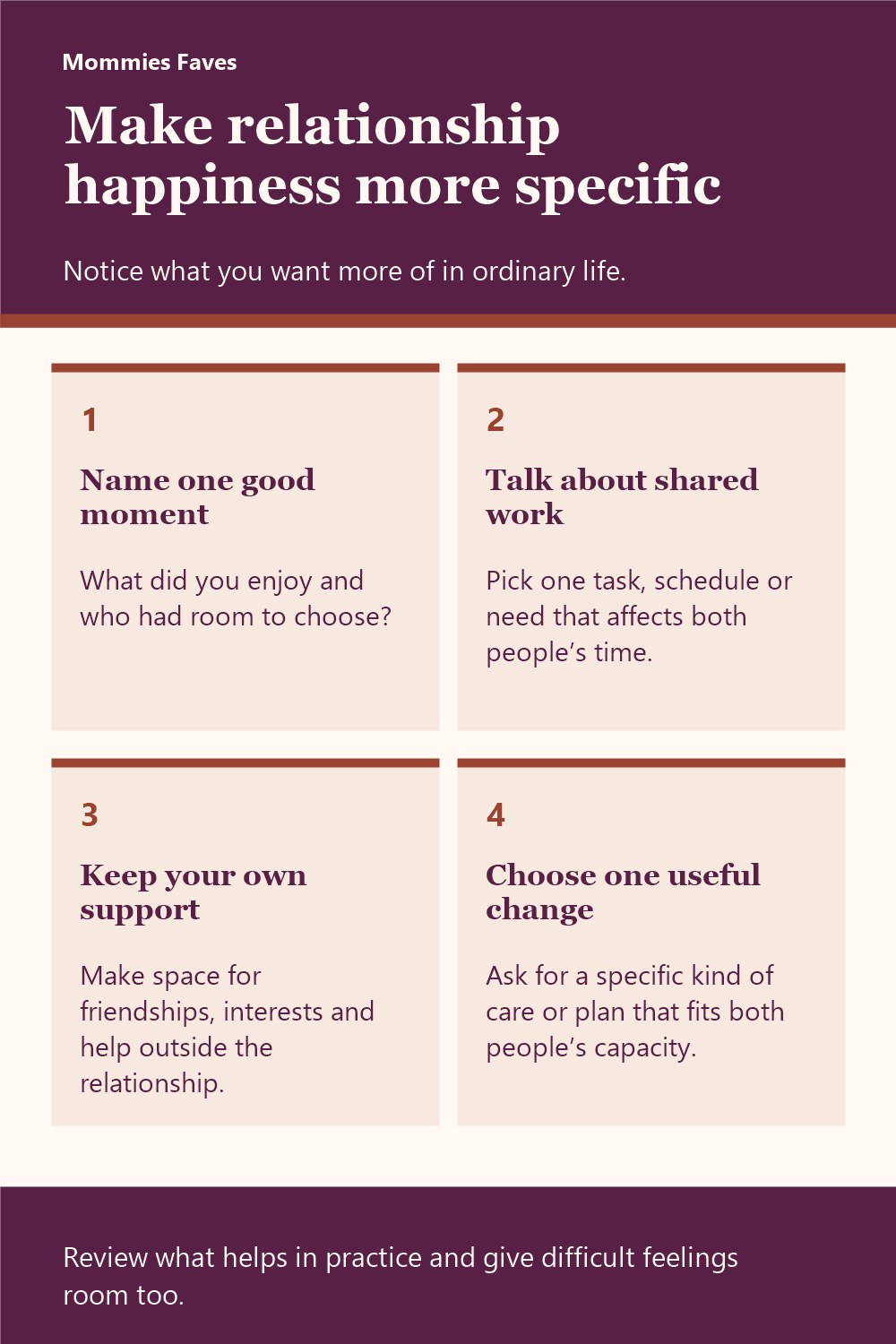
Read the infographic in text
Make relationship happiness more specific Notice what you want more of in ordinary life.
- Name one good moment What did you enjoy and who had room to choose?
- Talk about shared work Pick one task, schedule or need that affects both people’s time.
- Keep your own support Make space for friendships, interests and help outside the relationship.
- Choose one useful change Ask for a specific kind of care or plan that fits both people’s capacity.
Review what helps in practice and give difficult feelings room too.