

A personality description can give you words for a difference you have noticed: how you like to spend an evening, talk through a decision or make plans. It cannot tell you that someone will be a loyal partner, want a lasting relationship or share your values.
The Myers-Briggs Type Indicator, or MBTI, describes personality preferences through four-letter type codes. If you enjoy the framework, you can use it to begin a conversation. Choosing a partner still calls for getting to know the individual, discussing what you each want and noticing how you treat one another.
On this page
1. Understand what a type description offers
Think of a type description as a proposed way to understand preferences, rather than a complete account of a person. You may recognise parts of it and find that other parts do not fit. A partner may also describe their own experience differently from what you expected.
The Myers & Briggs Foundation’s ethical guidance says type should be discussed as preferences rather than absolutes. It warns against assuming that everyone with the same type behaves alike or choosing a personal relationship on type information alone.
Keep the person involved in the conversation. Ask, “Does that description sound like you?” rather than assigning a code based on a quiet evening or an outgoing manner. Someone can decline to take an assessment or share a result. Knowing their code is not a condition of being allowed to get to know them.
Use your own words when a label becomes unhelpful. “I like a little notice before plans change” describes something your partner can respond to. “That is just my type” may leave the actual request unclear.
2. Set aside rankings of the best partners
No four-letter code is a certificate of kindness, honesty or commitment. Describing ISFP, ESFJ, ENTJ or INTJ as the best long-term partners assigns qualities to people before you know how they act. The same problem applies to a list of types you should automatically avoid.
The Foundation’s information on type and relationships states that there are no best or more successful type combinations. Shared preferences and different preferences can both occur in relationships that work well.
Similarity may make some choices feel familiar while leaving other needs unresolved. Difference can be interesting while also creating practical friction. Neither pattern tells you whether both people want to listen, make adjustments or keep agreements.
Ask a more useful question about this particular connection: can we discuss a difference and find an arrangement we both want? A reassuring match description cannot supply an answer that the relationship itself has not shown you.
3. Turn differences into practical questions
Begin with something that actually happens between you. Choose a small, recent situation and describe what each person needs, without deciding whose personality is the problem.
Time together and time alone
One person may want company after work while the other needs quiet first. Try: “Would half an hour to yourself help before we talk, and could we agree when to reconnect?” The point is to make both needs visible, rather than treating a preference for quiet as rejection or a wish to talk as excessive.
Planning and changes
You may enjoy spontaneous dates but need advance notice to arrange childcare. Be specific: “I can consider a last-minute coffee, but an evening out needs planning. Can we confirm by Thursday?” A preference for flexibility does not make the practical cost of a cancelled sitter disappear.
Talking through decisions
One person might think aloud while the other wants time to reflect. You could share the question beforehand and choose a time to return to it. “I want to think about this tonight and discuss it tomorrow” gives more clarity than assuming a slow answer means indifference.
Review what happened after trying the agreement. Did it make life easier? Did both people follow through? If the same difficulty remains, adjust the arrangement or consider whether it is workable. You do not need matching labels to ask those questions.
4. Look at commitment through behaviour
If you want a long-term relationship, ask what the other person wants now. A type description that mentions loyalty or future goals cannot override a direct statement that someone prefers casual dating or does not want a relationship.
Notice ordinary patterns: whether plans are usually kept, changes are communicated and your concerns receive a respectful response. Mistakes can happen; the response to a mistake and the willingness to make a practical repair matter too.
Our guide to kindness you can notice and expect in a relationship offers examples of consideration, follow-through and mutual care.
Keep important questions separate from type. Do you want similar levels of commitment? Can you discuss money, time, parenting responsibilities or where you would live? Are your boundaries about privacy and physical affection respected? Shared letters cannot settle a real difference in those areas.
A personality explanation also does not excuse insults, threats, coercion or monitoring. You can take an uncomfortable pattern seriously without proving that someone has the wrong type. If raising a concern feels unsafe, seek confidential individual support before arranging a confrontation.
5. Make your choice without a type verdict
Using a personality framework is optional. You can enjoy comparing descriptions while keeping the discussion open to correction, or you can talk directly about preferences without an assessment. Neither person needs to buy a test to have a useful conversation about the relationship.
If you keep using type language, ask whether it is helping. Does it make a request clearer, or does it keep ending the conversation with “That is how I am”? Can both people disagree with a description? Are you still noticing the actual person rather than fitting every action into the label?
Choose a next step based on the arrangement available now. You might discuss one practical difference, take more time getting to know each other or decide that your needs do not fit. You do not need a compatibility chart to grant permission for that decision.
A long-term partnership is something two people choose and participate in. Personality language may offer a starting point for understanding; your agreements, actions and freedom to choose remain part of every next step.
Read the infographic in text
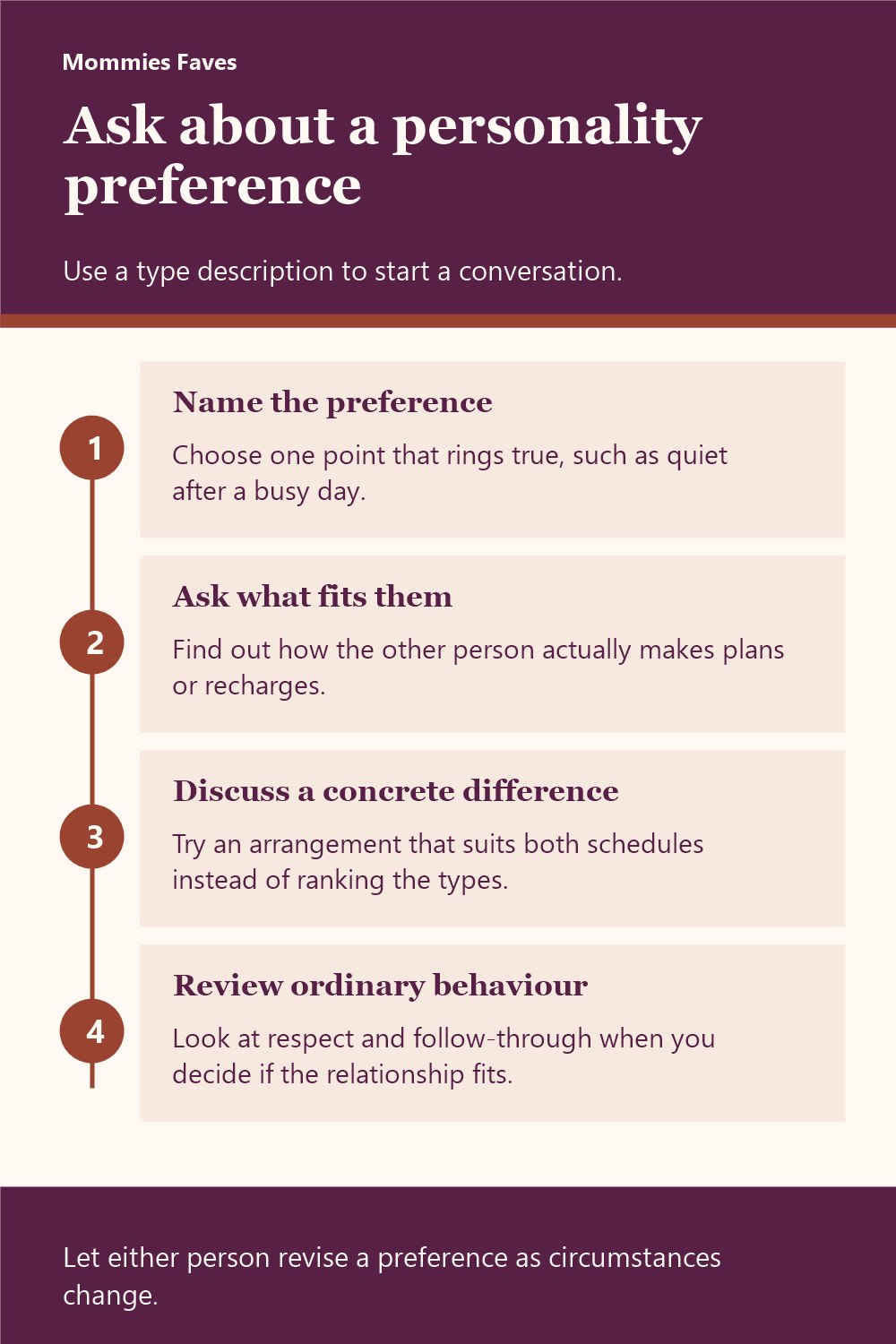
Ask about a personality preference Use a type description to start a conversation.
- Name the preference Choose one point that rings true, such as quiet after a busy day.
- Ask what fits them Find out how the other person actually makes plans or recharges.
- Discuss a concrete difference Try an arrangement that suits both schedules instead of ranking the types.
- Review ordinary behaviour Look at respect and follow-through when you decide if the relationship fits.
Let either person revise a preference as circumstances change.