

A useful co-parenting message lets the other parent find the information they need: the child-related topic, relevant facts, a clear request and any genuine deadline. Brief means removing unrelated argument, while keeping enough detail for care and decisions.
Follow the parenting plan, court orders and safety arrangements that apply to your family. A better sentence cannot make an unsafe communication arrangement safe.
Build a message the other parent can act on
Read the guide as text
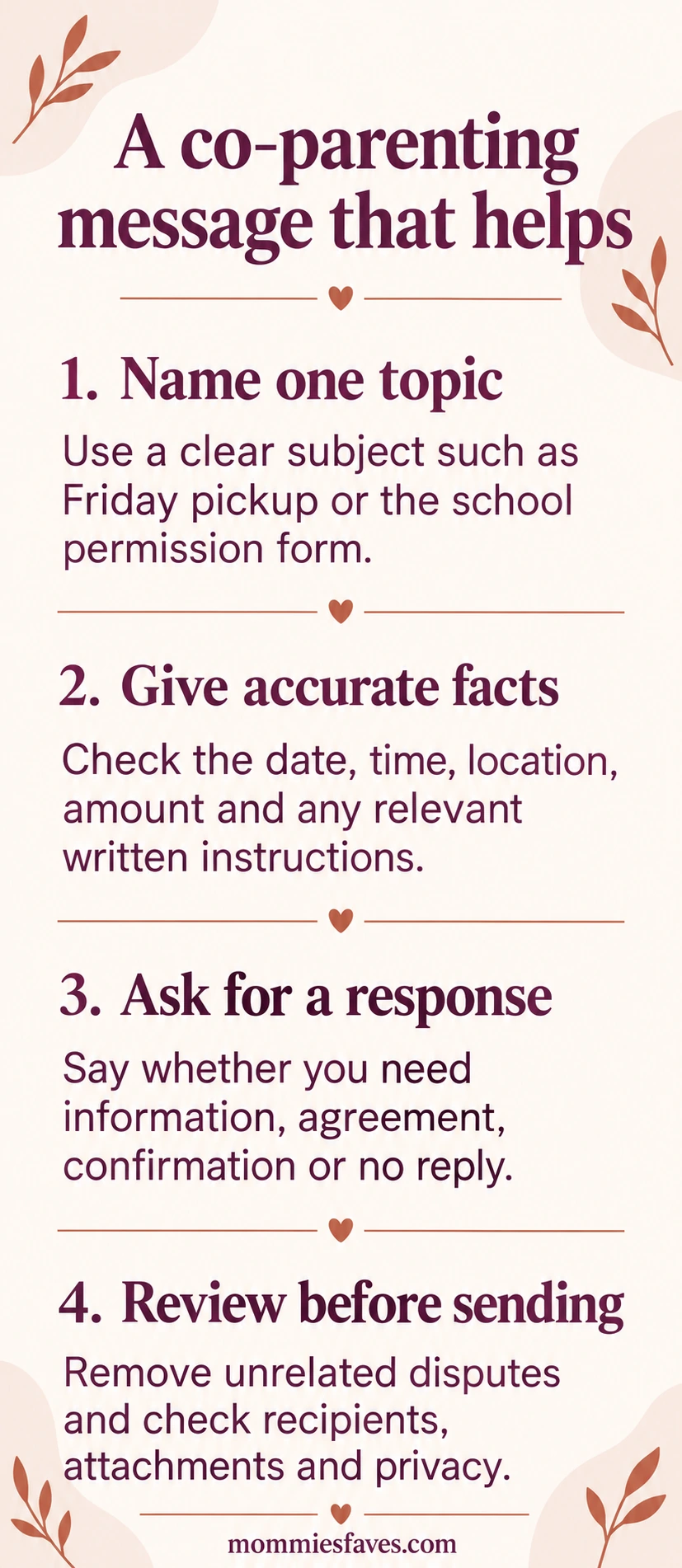
- Name one topic. Use a clear subject such as Friday pickup or the school permission form.
- Give accurate facts. Check the date, time, location, amount and any relevant written instructions.
- Ask for a response. Say whether you need information, agreement, confirmation or no reply.
- Review before sending. Remove unrelated disputes and check recipients, attachments and privacy.
Defining Your Job
Before typing, you should ask: what does the other parent need to know? A job might mean confirming a handover, sharing appointment results, asking for agreements, or telling someone about a change.
If the answer is for them to understand how much they hurt you, then this message needs to be handled separately. This might be something that needs support, but this has nothing to do with picking someone up from school.
Try writing what you need first, such as, “Can you confirm who will pick up Jon at 3:15?” Then you can add more context if you want to make different decisions. This helps to reduce the chance that the request gets hidden under your frustration.
Instead of starting with talking about a time when the other parent couldn’t pick up the child, you should say something like, “The school closes early on Friday; can you pick up Jon at 1? Please let me know by Wednesday so I can make other arrangements if I need to.”
Following Communicated Arrangements
If an order, parenting plan, or safety arrangement has a certain process, then follow it. Don’t go to a new app or a new contact method just because it seems easier.
Where direct communication is safe and permitted, agree on practical expectations. Clarify the channel for the messages, urgent matters, and sending documents. Talk about realistic response times, work schedules, disability, care responsibilities, and technology.
Justice Canada's advice on electronic parenting communications encourages keeping exchanges focused on parenting matters. It is a useful general reference, while legal requirements depend on your own jurisdiction and circumstances.
An app doesn’t mean that communication is safe. Consider if you can access accounts if notifications show information, what the service stores, and if using it is consistent with the arrangements that you have to follow.
Being Clear
Having an easy structure needs topics, relevant facts, requests, and responses. Not every message has to have each of these things, but these things help a reader find the point.
For example: “Sam’s dentist appointment is Tuesday at 3 p.m. at the usual clinic. I can take him. Please confirm by Sunday whether that fits our agreed arrangements.”
If you need to give an update, then say something like, “For information only, there is no reply needed.” If you need confirmation, then ask for confirmation instead of just thinking that silence means that they agree with you.
Keep issues that aren’t relevant separate. A request about Saturday’s pickup is easier to answer when it isn’t added with questions about expenses, complaints about a family member, or questions about the following summer.
Using Dates
Saying things like later or tomorrow can get confusing if someone reads the message hours later. Use a full date, time, and location when needed. See if the date and time match, and if you travel across time zones then don’t think that everyone thinks that 6 pm is the same.
You can say something like, “Pickup is going to be at the community center on Friday, October 23 at 5 p.m. local time.” Add other details if needed, but don’t reveal addresses that are protected.

Clearly distinguish a proposal from a confirmed arrangement. If you ask to change the time, this isn’t the same as the time having changed. Follow the consent and decision-making process before you see a suggestion as an agreement.
Keep the Other Parent Updated About Health Concerns
When your child has a health problem or needs medical attention, it's important to keep the other parent informed about what's happening. Try to focus on the facts, including what symptoms your child experienced, what the healthcare professional recommended, and whether there's anything that needs to be done. You don't need to guess about what might be wrong or turn the conversation into an argument about how the other parent takes care of your child.
For an illustrative example, imagine Emily taking her son, Jacob, to the doctor because he's been complaining about ear pain. After the appointment, she might send his father a message saying, "Jacob went to the doctor today because his ear was hurting. The doctor gave us some instructions, and I've attached a copy so you can look them over. His medication schedule is included in the instructions. Please let me know that you received everything." This keeps the other parent informed without adding unnecessary details or criticism.
If your child needs medication, always make sure that the name, dosage, and times are correct before sharing that information. Check the prescription label or written instructions from the healthcare professional instead of relying on your memory. If something isn't clear, contact the doctor or pharmacist rather than guessing. Both parents need accurate information so that the child receives the proper care.
It's also important to remember that serious health concerns shouldn't have to wait until you finish writing the perfect message. If your child needs immediate medical attention, getting help should always come first. Afterward, you can update the other parent using the communication arrangements you already have in place and following any legal requirements that apply. The goal is to make sure your child is safe, and both parents have the information they need.
Be Clear When Discussing Expenses for Your Child
Money can sometimes become a source of disagreement between parents, especially when it involves expenses that weren't planned ahead of time. When you need to ask the other parent to contribute to something for your child, try to keep the message simple and include all the important details. Explain what the expense was for, when it happened, how much it cost, and what amount you're requesting. If you have a receipt, include it so the other parent can see exactly what was paid.
For an illustrative example, imagine Rachel paying $60 for her daughter's school field trip. If their parenting agreement says that they split this type of expense equally, she might send a message saying, "Sophia's school trip cost $60, and I paid it on October 12. I've attached the receipt for you to look at. According to our agreement, your half would be $30. Can you let me know when you'll be able to send it?" This makes the request clear without turning it into a disagreement.
But it's important not to assume that every expense automatically needs to be shared. Some parenting agreements require both parents to discuss certain purchases before they're made, while others explain exactly which expenses each parent is responsible for. Make sure you're following the arrangement that applies to your situation instead of assuming that the other parent should contribute simply because you believe the expense was necessary.
You should also try to keep financial disagreements separate from your child's relationship with either parent. Children shouldn't be asked to collect money, carry messages about unpaid expenses, or feel that spending time with a parent depends on whether a payment has been made. If you and the other parent can't reach an agreement, it might be necessary to use mediation, legal advice, or another appropriate way to resolve the problem instead of continuing to argue through messages.
Address Problems Without Turning Every Message into an Argument
When you're frustrated with the other parent, it can be tempting to bring up everything they've done wrong in your messages. However, adding blame or criticism can sometimes make it harder to deal with the actual problem. Instead of focusing on what you believe the other parent never does, try explaining what needs attention and what response you're looking for.
For example, instead of sending a message that says, "You never pay attention to anything the school sends home," you could say, "The school needs the permission form signed by Thursday. Have you had a chance to look at it?" Both messages address the same concern, but the second one makes it easier for the other parent to respond without immediately becoming defensive.
If the same problem keeps happening, you don't have to pretend that everything is fine. You can explain what's been happening by using specific examples instead of making general accusations. For example, if the other parent has been late picking up your child, you might say, "The last two pickups were more than 30 minutes late, and that made it difficult to keep our evening routine on schedule. Can we talk about a pickup time that works better?" This explains the concern and gives both parents an opportunity to find a solution.
Remember that communicating respectfully doesn't mean ignoring serious problems or taking responsibility for things that aren't your fault. If the other parent is threatening, controlling, or abusive, you shouldn't feel pressured to make the situation sound less serious just to avoid conflict. In those situations, keeping accurate records, protecting your safety, and getting appropriate professional or legal support are more important than trying to make every conversation appear friendly.
The goal of keeping messages calm and clear isn't to pretend that you and the other parent will always get along. It's to make sure that important information doesn't get lost in arguments and that your child's needs remain the main focus. Sometimes changing how you communicate can help prevent unnecessary disagreements while still allowing you to address problems that need to be resolved.
When Change is Needed
When a change is needed, there need to be at least two options, and this can be an easier way to respond to questions. You can say something like, “I can go to the appointment on Monday or on Tuesday afternoons; which day are you able to go?”
Only give options that are there and that are consistent with parenting arrangements. Do not offer a choice that changes rights or responsibilities you are not authorised to change.
If none of the options work, look at the next process, such as contacting the school, talking about another appointment, or getting advice from a professional. A message on its own cannot solve all the conflicts by changing the wording.
Two parents cannot always attend an evening school event because of work, for example, and so, as a response, they can ask the teacher if the information can be shared with them separately. One solution comes by adjusting the arrangements instead of arguing about which parent shows more care.
Giving a Response
A reply can be full of useful information, but it can still be full of criticism. You can answer the questions related to the child without defending yourself constantly. If the message says something like, “As normal, you can’t organize anything. Is the collection still happening at five?” A response might be, “Yes, the collection is still on Friday at 5 at the agreed location.”
This doesn’t mean that you have to pretend that them insulting you was okay, but instead document your concerns and set appropriate boundaries or get advice from professionals if the pattern gets harmful. You don’t have to allow insults just for scheduling issues.
If a response has a threat or causes risk to the child, see this as a safety issue. Don’t just ignore the tone if it needs professional help or emergency intervention.
Know What to Do When the Other Parent Doesn't Respond
Sometimes you might send the other parent an important message and never receive an answer. This can be frustrating, especially when you're trying to make decisions about your child's school activities, appointments, or everyday responsibilities. Before sending another message, look back at what you originally wrote. Did you clearly explain what you needed? Did you ask a specific question or give the other parent a reasonable amount of time to respond? Sometimes a message might seem clear to you, but the other person might not realize you're expecting an answer.
If you haven't received a response, try sending a short follow-up that explains exactly what you need and when you need it. For example, you might say, "I'm checking to see whether you've signed the permission slip for the school trip. The school needs it by tomorrow, so please let me know by 6 p.m. today." This reminds the other parent about the situation without adding unnecessary criticism or starting an argument.
It's also important not to send messages repeatedly every few minutes just because you're frustrated. Unless there's an emergency, calling several times or sending the same message through different apps can make the situation more stressful. It can also make it harder to keep track of your conversations if you ever need to refer back to them. Sometimes giving the other parent a reasonable opportunity to respond is better than continuing to send messages.
If the other parent regularly ignores important messages and it begins affecting decisions about your child, you might need to look at your parenting agreement or get legal advice about what options are available. Some agreements explain what happens when a parent doesn't respond, while others don't. You shouldn't assume that silence automatically gives you permission to make a major decision on your own. The goal is to communicate clearly while still respecting any legal arrangements that apply to your situation.
Don't Put Your Child in the Middle of Adult Communication
When parents are having trouble communicating, it's important to remember that children shouldn't be responsible for passing messages or handling disagreements. Your child shouldn't have to remind the other parent to answer a text, explain why someone is angry, or show private messages between adults. Even when it seems like a simple request, involving children in these situations can make them feel uncomfortable or responsible for problems they didn't create.
Try to keep communication between you and the other parent instead of using your child as the messenger. It's also important to be careful about how you describe things your child tells you. For example, if your son, Benjamin, says that he's nervous about traveling somewhere, you could tell the other parent, "Benjamin mentioned that he's feeling nervous about the trip." That's different from saying, "Benjamin doesn't want to spend time with you." The first statement explains what your child actually said, while the second adds an interpretation that might not be accurate.
If your child tells you something that makes you concerned about their safety, take those concerns seriously and consider getting appropriate professional help. However, you shouldn't repeatedly question your child or encourage them to say certain things just to support an argument with the other parent. Children should feel comfortable talking about their experiences without feeling that they need to provide evidence or take sides in a disagreement.
You also shouldn't ask your child to help you write or review messages about the other parent. If you're upset and aren't sure how to word something, consider asking a trusted adult, counselor, or another qualified professional for help. Your child should be able to focus on school, friendships, and everyday activities without worrying about managing communication between their parents.
The most important thing is making sure your child feels loved and supported by the adults in their life. Even when parents disagree or have difficulty communicating, children shouldn't feel that it's their responsibility to fix the problem. Keeping adult conversations between adults can help protect your child's emotional well-being while allowing both parents to focus on what's best for them.
Protecting Privacy
Anytime you send out a message, it can be saved, forwarded, or looked at by others. Write what you want to say without giving away personal information, medical information, or other things that aren’t relevant to the child’s health, or information about a new partner.
Before you add documents, look to make sure that you are sending them to the right person and that you don’t have addresses, account numbers, or other sensitive information that doesn’t need to be shared. Always use a secure method when needed.
Keep records so that you can stay consistent with your local laws and safety needs. Don’t try to access someone else’s accounts or try to access or change their messages. Ask what records can be helpful if there are legal issues, but always ask a professional.
Privacy is especially important in family violence situations. Justice Canada's family violence and parenting information explains that violence can affect appropriate parenting arrangements. A requirement to communicate should not be mistaken for a requirement to ignore risk or disclose protected information.
Tone of the Message
Even if you write a good message, it doesn’t mean that the reply will be kind. It might be that the message was necessary and the message delivered clearly, but you didn’t add an unrelated dispute.
After sending the message, go back to your own responsibilities when you can. You don’t need to monitor the message continuously if the matter is something that is routine and a good response window has been set.
If every message leaves you feeling stressed, then consider support for yourself and get advice on whether a better communication structure would work. Giving more effort from one parent doesn’t create cooperation.
Editing Check
Before you send, ask if the message has a topic, facts, and a clear question or request. Always pay attention to deadlines. Take time to verify dates, names, amounts, attachments, and recipients.
Then take away anything whose main purpose is to fight an old argument. Keep the information that you need for safety, medical care, or the needs of the child, even if the message has to be longer than you wanted it.
Read it once from your perspective and then the perspective of the recipient. Ask if they are able to tell what you are asking without guessing. If the answer is yes, then don’t edit anymore. A normal message doesn’t have to be a perfect writing piece.
Writing a clear co-parenting message takes important information and makes it easier to use. With the right arrangements and the right support, it can help to reduce confusion and keep attention on the child.
Build a brief co-parenting message
Choose one topic and the response you need. Replace every bracketed detail before using the draft.
Follow current court orders, parenting arrangements and safety requirements. Do not use the child to carry the message.
Use the questions and examples in the article above; the draft builder needs JavaScript.
15 questions readers ask
1. How long should a co-parenting message be?
Long enough to give the information needed for the topic. Two sentences may suit a pickup confirmation, while a health update can need more detail. Brevity should not remove essential information.
2. What is a simple message structure?
Name the topic, state relevant facts, ask for a specific response and give a genuine deadline if needed. Check that the reader can tell what action you are requesting.
3. Can you give a pickup example?
“The school closes at 1 p.m. on Friday, November 6. Can you collect Alex at the agreed pickup point? Please confirm by Wednesday at 6 p.m.” Use dates and arrangements that are accurate for your family.
4. How do I show that a plan is only a proposal?
Use words such as “Could we” or “I propose,” and request confirmation. Do not describe a suggested change as agreed before the required consent or decision process has happened.
5. Does no reply mean agreement?
Do not assume that it does. Follow your parenting arrangement and applicable rules. For an important decision, obtain the confirmation required or seek appropriate advice.
6. What should a health update include?
Share relevant observed symptoms, the professional’s instructions and what the other parent needs to do. Verify medication details against written instructions and ask a clinician or pharmacist if unclear.
7. Should I wait to message before obtaining emergency care?
No. Seek urgent care when needed, then communicate through the appropriate arrangements and follow applicable requirements. A routine message should not delay necessary help.
8. How can I ask about an expense?
Identify the child-related cost, date, receipt and amount requested under your actual agreement. Check whether prior consent was required rather than assuming every expense must be shared.
9. How should I reply to an insult mixed with a practical question?
You can answer the necessary child-related question without arguing about the insult. Persistent harassment, threats or control may require documentation, specialist support or changes through the proper process.
10. What if the other parent does not respond?
Check that your request was clear and send one proportionate follow-up when useful. Refer to your agreement for next steps. Repeated messages across several channels may add confusion or risk.
11. Can I choose a new messaging app on my own?
Follow any required channel first. Where a choice is permitted, discuss access, notifications, privacy and record handling. An app alone does not make communication safe.
12. Should children pass small messages for us?
Keep adult coordination between adults. A child should not carry requests, monitor replies or manage a parent’s emotions, even when the message seems simple.
13. Can I quote something my child said?
Report relevant words accurately without turning them into a broader conclusion. Take safety concerns seriously and seek appropriate help without repeatedly questioning or coaching the child.
14. What should I remove before sending?
Remove unrelated relationship disputes and unnecessary private information. Check attachments for protected addresses, account details and information that the recipient does not need.
15. What changes if there has been family violence?
Prioritise specialist safety and legal guidance, existing orders and protected information. Ordinary cooperative co-parenting scripts may be unsuitable where there is intimidation, stalking or coercive control.