

If someone is threatening, humiliating, pressuring or repeatedly contacting you in an unwanted way, you may be wondering whether to report it. You can seek support and raise a concern without first proving the exact legal term for what happened.
Start with safety, the setting and the help you need. A workplace complaint, a school report, a platform report and a legal claim follow different processes. Rules and deadlines depend on your location and circumstances. Talking about the problem may help you find support, but responsibility for the behaviour belongs to the person doing it.
If you or someone else is in immediate danger, contact local emergency services when it is safe to do so. You do not need to wait for another incident before seeking urgent help.
On this page
1. Raise a workplace concern early
Read your employer’s reporting policy if one is available. It may identify a manager, human-resources contact, union representative or another route. If the person you would normally approach is involved in the conduct, look for an alternative named contact.
Describe what happened rather than trying to diagnose the person’s motives. Unwanted touching, threats, discriminatory remarks or pressure linked to a workplace benefit deserve attention. Conduct can involve a colleague, supervisor, customer or someone you encounter through work, including online.
In the United States, the EEOC’s workplace-harassment guidance explains the particular standards used under federal employment-discrimination law. It notes that extremely serious isolated incidents can be an exception to the usual treatment of isolated conduct. Do not assume that something must happen repeatedly before you can raise a concern. An internal policy may also address behaviour beyond what a particular law covers.
2. Ask about possible retaliation
You may worry about losing hours, receiving threats or being treated differently after speaking up. If something changes, record the dates, what changed and any explanation you were given. Keep the description factual, including information that does not fit your initial understanding.
The EEOC explains U.S. protections against retaliation for asserting rights under employment-discrimination laws. Whether a particular action is unlawful depends on the facts and applicable rules; a report does not make every later workplace decision retaliation. Ask an appropriate adviser or agency about your circumstances and any deadlines. You can also ask the employer how concerns about retaliation should be reported.
3. Report unwanted sexual conduct without pressure to confront
Unwanted sexual comments, touching, sexual images or pressure for sexual contact can be reasons to seek help. A demand for sexual contact in exchange for a work or study benefit is a serious concern. People of any gender can be affected.
You can say that behaviour is unwelcome if you feel able and safe to do so. You do not have to arrange a private confrontation as your only route to support. The EEOC’s employee questions and answers describes approaching an employer when direct confrontation feels uncomfortable or the behaviour continues.
Choose what you feel ready to share, and ask how the information will be handled. A friend or support person may help you prepare. A reporting process cannot guarantee a particular outcome, so it is reasonable to ask what help is available while the concern is considered.
4. Take threats and stalking concerns seriously
Being followed, threatened, assaulted or monitored can require a response focused on safety. You do not need to decide whether conduct meets the local definition of a crime before asking for urgent help or advice about protection.
If the risk is immediate, contact local emergency services when safe. Otherwise, a local specialist support service or police non-emergency service may explain options. Consider whether the person can access your phone, accounts or location, and use a safer way to seek support if necessary.
Preserve messages or other records you already have if doing so is safe. Avoid putting yourself at risk to gather more evidence, and ask the relevant service what information would be useful. Reporting does not require you to confront the person first.
5. Help a student reach appropriate support
If a child or young person reports bullying, unwanted sexual behaviour, threats or other concerning conduct, listen without blaming them. Ask what happened and whether they feel safe now. Help them approach a trusted teacher, counsellor, safeguarding contact or school leader through the school’s reporting process.
StopBullying.gov’s help guide lists school contacts and escalation options in the United States, along with reporting routes for cyberbullying. Elsewhere, check the school and local education authority’s arrangements. For a college or university, look for its student-support and misconduct-reporting contacts.
Ask what will happen next, who needs to know and how the student can get help if the behaviour continues. Do not promise secrecy or a result you cannot control. A student should not have to manage a frightening situation alone.
6. Consider safety at home and in relationships
Threats, forced sexual contact, violence, intimidation, isolation or controlling access to money and other people are concerns about safety and abuse. They should not be reduced to an ordinary disagreement or a problem you must solve by explaining yourself more clearly.
The NHS information on domestic abuse describes signs and support options in the UK. In other locations, a local domestic-abuse or sexual-violence service can help you consider options suited to your circumstances. You can seek support before deciding whether to make a formal report or leave.
If a partner or former partner may react dangerously, consider private specialist support before announcing plans or confronting them. Your safety and practical needs matter, including any children or other people who depend on you.
7. Make a clear report and plan a follow-up
A useful report can begin with a brief factual account. Include what you can safely provide:
- The date, time and place, or the online platform involved.
- What was said or done, using specific details rather than guessing intent.
- Any relevant messages, records or witnesses you know about.
- How the situation is affecting you and what help you are requesting.
Ask for acknowledgement, the next step and a likely follow-up time. You can also ask who will see the information, what privacy limits apply and whom to contact if there is another incident. Keep a copy of your report where it is safe for you to do so.
If you may want action outside the organisation, ask the relevant agency or a qualified local adviser about deadlines promptly. When supporting someone else, listen to their wishes and offer practical help. If you have a professional reporting duty, check that obligation with the appropriate designated contact rather than assuming a general article settles it.
Read the infographic in text
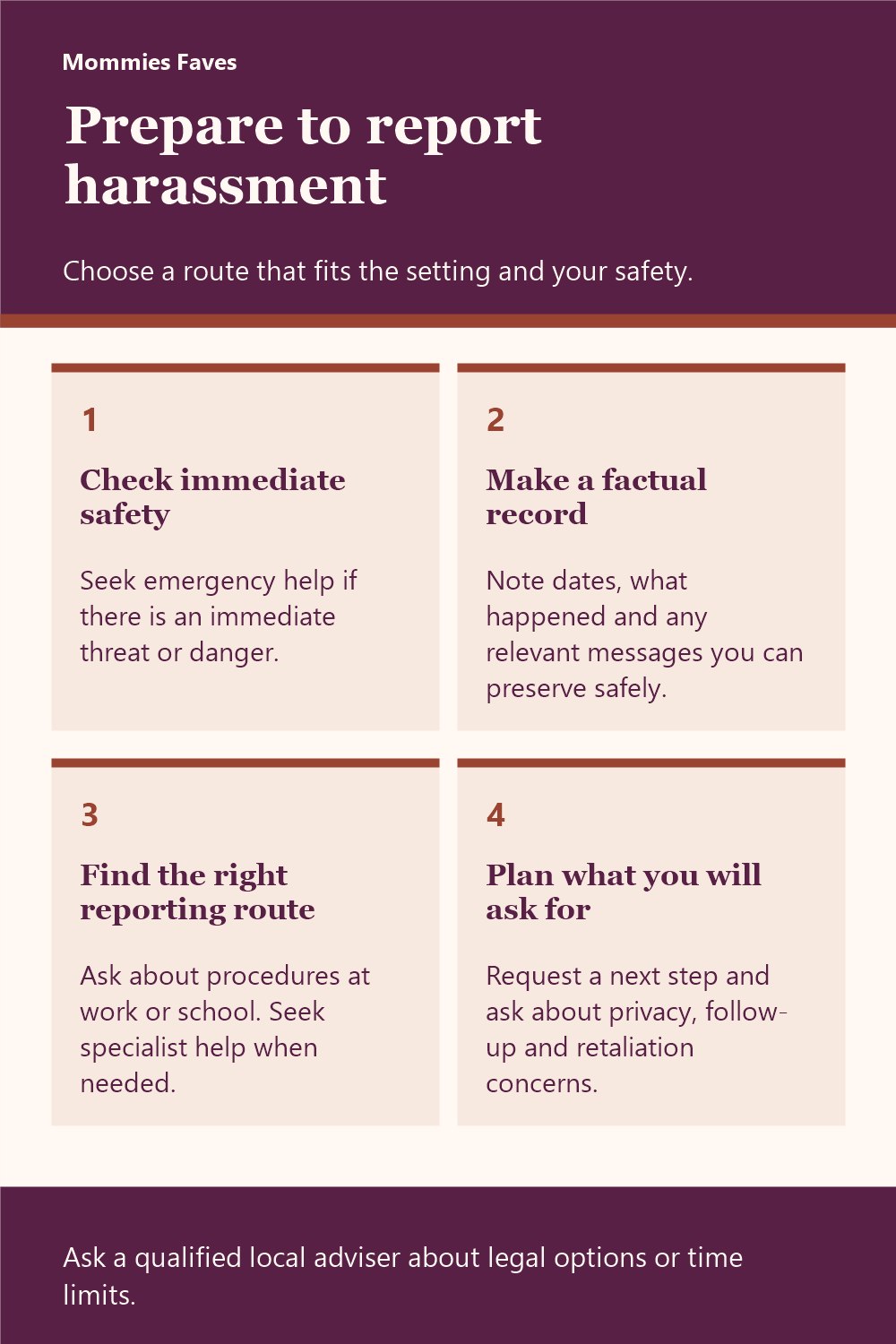
Prepare to report harassment Choose a route that fits the setting and your safety.
- Check immediate safety Seek emergency help if there is an immediate threat or danger.
- Make a factual record Note dates, what happened and any relevant messages you can preserve safely.
- Find the right reporting route Ask about procedures at work or school. Seek specialist help when needed.
- Plan what you will ask for Request a next step and ask about privacy, follow-up and retaliation concerns.
Ask a qualified local adviser about legal options or time limits.