

Finding it hard to trust someone can involve past experiences, current behaviour or both. You may want closeness and still feel uncertain. Labelling the concern a “trust issue” does not tell you whether a partner is being reliable or what you need to feel comfortable.
Start with the specific concern and the choices available now. You do not have to forgive, rebuild a relationship or prove complete trust on a deadline. Equally, worry does not justify controlling another person or searching through their private information.
In this article
Separate the current concern from the prediction
Describe what happened as plainly as you can. “They cancelled twice without explanation” gives you something to discuss. “They will always abandon me” is a prediction that may feel convincing without being established by those events.
Your feelings still matter when the facts are incomplete. You can note what you observed, what you are assuming and what you want to ask. This is not an exercise in dismissing your judgement; it is a way to identify which question or boundary could help.
If a past betrayal comes to mind, notice the connection without deciding that a new person must repeat it. At the same time, do not explain away present dishonesty as merely your insecurity. Both your history and the other person’s current actions deserve attention.
Look for accountability after broken trust
If this person broke an agreement, rebuilding trust cannot rest entirely on your willingness to move on. Consider whether they acknowledge what happened, answer relevant questions and make practical changes. An apology can matter, while consistent actions provide different information.
For example, after repeated last-minute cancellations, you might agree to confirm plans earlier and communicate promptly when circumstances change. The agreement should address the actual problem, rather than requiring you to stop feeling disappointed.
Forgiveness, continued contact and reconciliation are separate choices. You can forgive and leave, stay uncertain or decide that you do not want to rebuild the relationship. No particular choice guarantees relief, and you do not owe one to make the other person feel better.
Notice the pattern over time
Look at what happens after a conversation. Does the agreed change occur? Can you raise a concern without being mocked or threatened? Are mistakes acknowledged, or do explanations repeatedly shift responsibility onto you?
You do not need to create secret tests to find out. Keep track of the agreements that affect your own decisions, while leaving room for ordinary mistakes and circumstances neither person controls. A pattern is more useful than trying to interpret every delay or tone of voice.
It is also reasonable to decide that the relationship no longer suits you. You do not need proof of infidelity or a final diagnosis of someone’s character to choose less contact. If you are afraid of their reaction, consider support and safer arrangements before announcing a change.
Ask for clarity while respecting privacy
Ask about the specific uncertainty: “Are we still agreeing to be exclusive?” or “What can we realistically expect about contact during the week?” A clear question gives the other person a chance to respond without requiring access to all their messages or accounts.
The love is respect guide to respecting a partner’s boundaries explains why privacy is not proof of secrecy. Demanded passwords, surveillance or restrictions on friendships are not a substitute for a trustworthy relationship.
You can ask for reassurance while recognising its limits. If the same question is being repeated without helping, pause and consider what remains unresolved. It may be a missing agreement, inconsistent behaviour or distress that would be useful to discuss with someone outside the relationship.
Choose your pace and support
A next step might be having one conversation, keeping an agreement for a while or taking distance. You can decide how much contact and closeness you want while you think. There is no requirement to become completely open before you are comfortable.
Try to keep ordinary support available: someone you can talk to, activities outside the relationship and practical help with responsibilities. If you are parenting, protect children’s privacy and keep adult relationship concerns with appropriate adults rather than asking children to investigate or reassure you.
Get help with the decision you face
If worry repeatedly disrupts sleep, daily tasks or relationships, a qualified professional can help you explore it. If someone is intimidating, controlling or threatening you, seek confidential specialist support and prioritise safety. You do not have to trust the person again or decide whether to stay before asking for help.
Trust can be considered through small, specific choices. Ask what you know, what you need and what the other person is actually offering. You can take those questions seriously without blaming yourself for having doubts or trying to remove all uncertainty from another person’s life.
Read the infographic in text
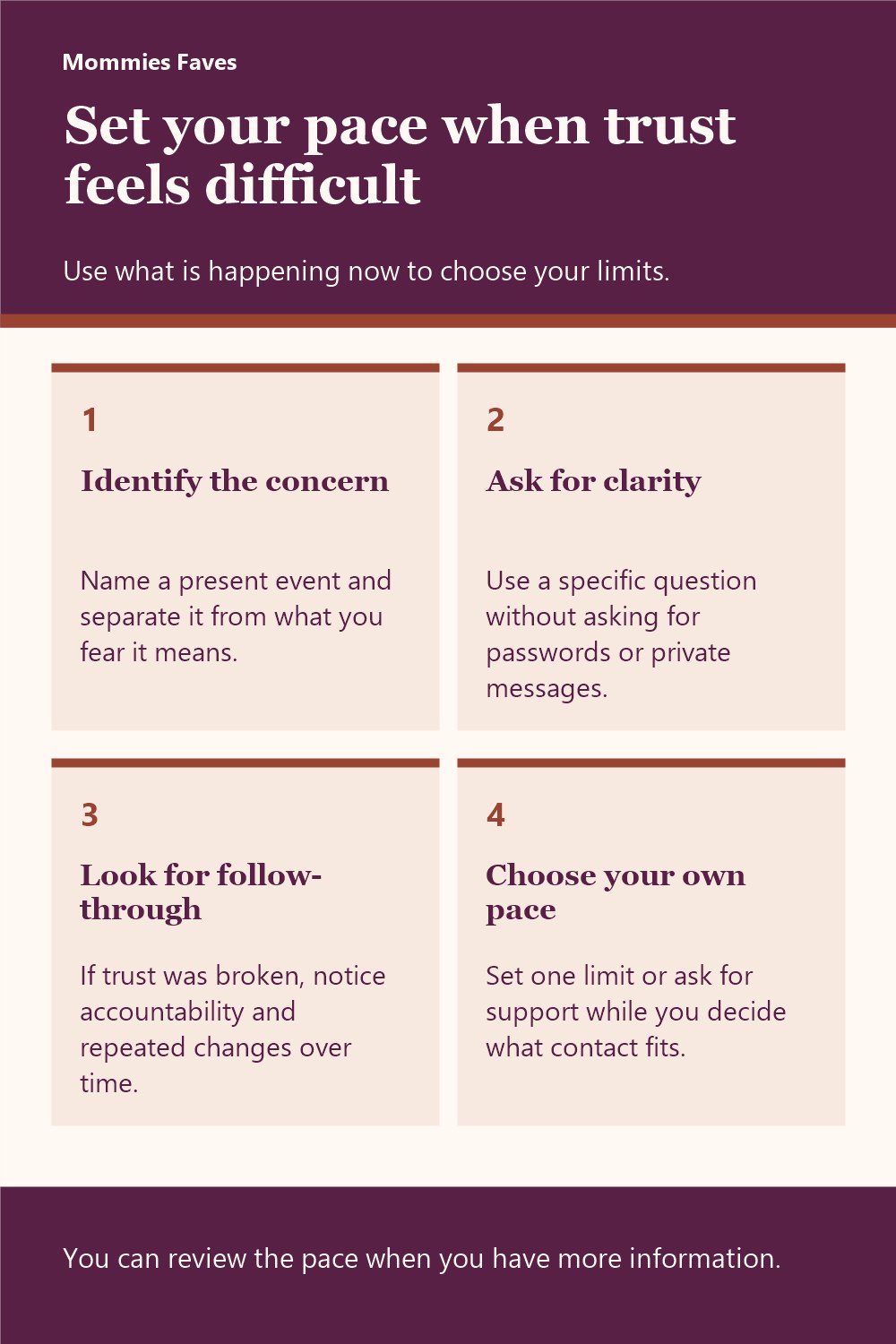
Set your pace when trust feels difficult Use what is happening now to choose your limits.
- Identify the concern Name a present event and separate it from what you fear it means.
- Ask for clarity Use a specific question without asking for passwords or private messages.
- Look for follow-through If trust was broken, notice accountability and repeated changes over time.
- Choose your own pace Set one limit or ask for support while you decide what contact fits.
You can review the pace when you have more information.