

A breakup can leave you looking for a way to understand your reactions. If the Enneagram is meaningful to you, its language may offer a starting point for reflection. You can use a familiar description to ask what you need today without expecting a personality label to explain the whole relationship.
The Enneagram groups personality patterns into nine types. Labels vary; the Enneagram Institute’s type descriptions use the names below. A 2021 review of Enneagram research found mixed evidence for its reliability and validity. A type cannot tell you how quickly you will recover, why your ex left or which coping choice will work for you.
Use any of these prompts that fits your experience, even if it belongs to a type you do not identify with. Skip what does not fit. Your circumstances, responsibilities and wishes matter more than completing every suggestion.
On this page
1. Reformer: ease the demand for a perfect explanation
If you keep reviewing what you should have done, separate something you can learn from a judgment about your whole character. You might regret avoiding a conversation without deciding that the breakup proves you failed as a person.
Ask: “Is there one specific thing I want to handle differently next time?” Write it down, then give yourself permission to leave the rest unresolved for now. You do not need a complete explanation before taking care of yourself.
2. Helper: include your own needs
If you are still organising your ex’s life or offering support you cannot sustain, pause before agreeing to another request. Caring about someone does not require you to remain available for every personal problem after a relationship ends.
Try: “I can discuss the children’s schedule, but I’m not available to talk about your dating life.” Adapt the limit to your circumstances. Asking a friend for company or practical help can also give your needs a place in the week.
3. Achiever: take recovery off the performance list
If you feel pressure to look successful, attractive or completely unaffected, notice what that performance costs. Work and goals may give your day structure, but you do not have to produce a better version of yourself to justify the breakup.
Choose a manageable priority, such as finishing one necessary task or arranging a quiet evening. Rest can belong in the plan. You can decline questions about how well you are “moving on” without offering a progress report.
4. Individualist: make room for feelings and ordinary moments
If a song, photograph or place brings back the relationship, you can acknowledge the memory without deciding it must guide your next choice. Missing someone does not establish that getting back together would suit either of you.
Writing, art or music may be ways to express what you feel. You can also put reminders aside when you need a break. An ordinary enjoyable moment does not make your past feelings less meaningful.
5. Investigator: turn one question into a practical action
If you spend hours analysing messages or reading explanations of your ex’s behaviour, ask what information you actually need. A clear answer about collecting belongings may help. A theory about their hidden motives may leave you with more questions.
Consider a small action outside the analysis: arrange the collection, eat a meal or check in with someone you trust. You can keep parts of your experience private while still asking for specific support.
6. Loyalist: identify support you can use now
If uncertainty feels difficult, list the immediate questions rather than trying to settle your entire future. You may need a plan for tomorrow’s school pickup, company at the weekend or help understanding an unfamiliar practical task.
Choose a reliable source for that particular need. A trusted friend can listen; a relevant professional can explain matters within their role. You do not have to resolve every possible risk before taking a modest next step.
7. Enthusiast: enjoy new things without rushing yourself
If you want a change of scene, an activity or time with friends may be welcome. You do not have to fill every evening or start dating immediately to prove that the relationship no longer matters.
Check the time, energy and money a new plan needs. Leave room to cancel, rest or feel sad as well as have fun. Enjoying yourself and missing someone can happen in the same period of your life.
8. Challenger: choose a response before acting on anger
If you feel angry, consider what you need before sending a message or seeking a confrontation. You might need distance, clarification about a shared responsibility or someone to listen while you decide what to do.
You can pause a nonurgent reply and return to it later. Keep necessary messages focused on their purpose. Threats, intimidation or attempts to punish an ex do not become acceptable because you feel hurt.
9. Peacemaker: give your preferences a voice
If you keep agreeing so that nobody becomes upset, ask what you would choose if your preference had equal space. You may want less personal contact, a different arrangement for a shared task or time to consider a request.
Try a brief response: “That time does not work for me. I can do Tuesday.” You do not need to assign all the blame for the relationship before expressing a limit. If saying no feels unsafe, seek support rather than forcing a confrontation.
Choose one manageable step
Choose one prompt that connects with your actual day. Try it, notice what helps and adjust it. You can keep using the Enneagram as a personal or spiritual reflection practice without treating it as a diagnosis or a recovery timetable.
If distress is persistent, worsening or interfering with everyday life, consider professional support. The National Institute of Mental Health’s guide to caring for your mental health explains everyday care and when to seek help. You do not need to know your type before asking.
Read the infographic in text
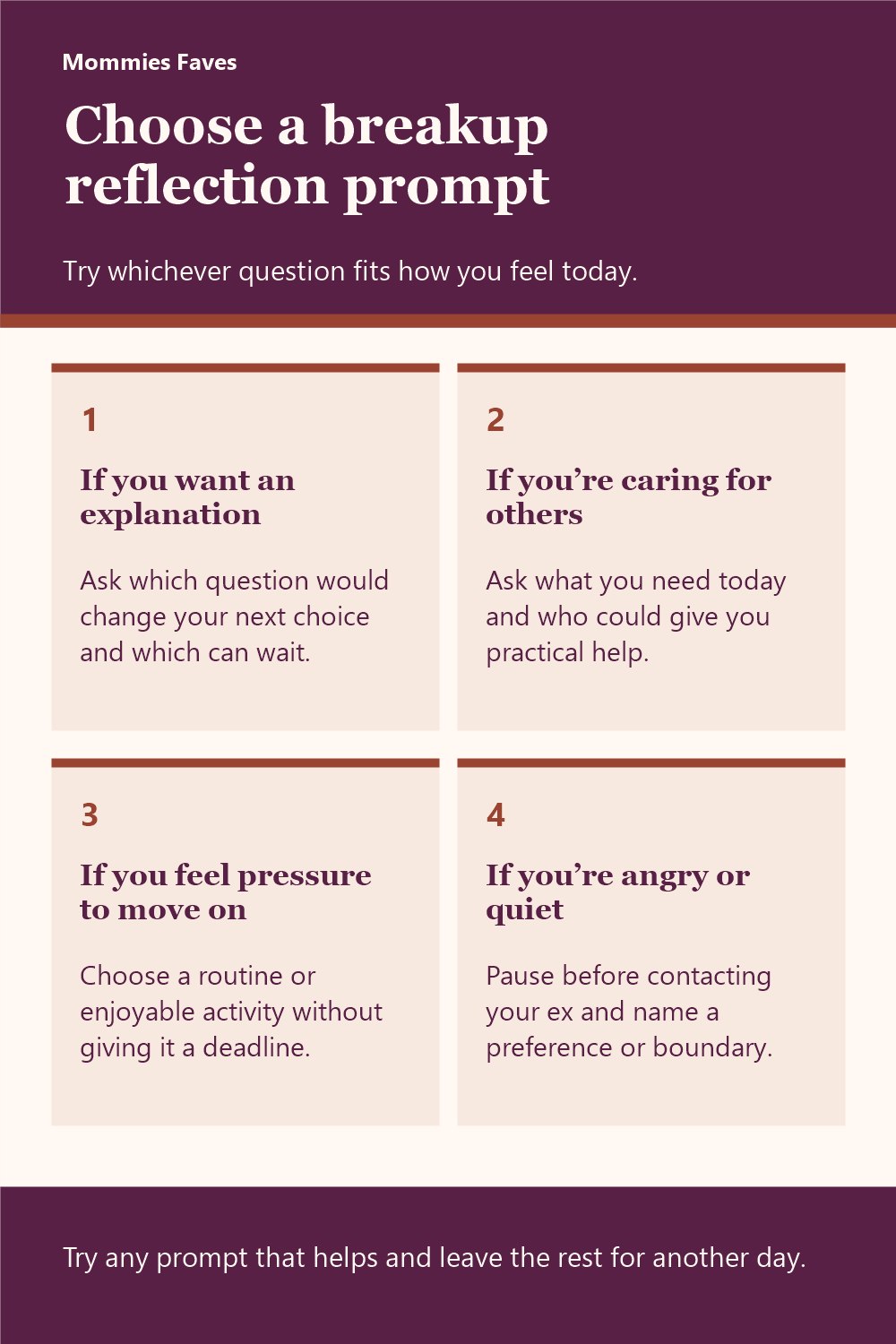
Choose a breakup reflection prompt Try whichever question fits how you feel today.
- If you want an explanation Ask which question would change your next choice and which can wait.
- If you’re caring for others Ask what you need today and who could give you practical help.
- If you feel pressure to move on Choose a routine or enjoyable activity without giving it a deadline.
- If you’re angry or quiet Pause before contacting your ex and name a preference or boundary.
Try any prompt that helps and leave the rest for another day.